Sanfang Keshong Rensheng Zhuangtai
The Vampire Prince’s BrideThree-parent cloned pregnancy is the condition in which Cheryl becomes pregnant with a child whose DNA derives from all three members of her chosen relationship with Bjorn and Maskin. It is both a biological breakthrough and a political reversal: a system that defines women through royal fertility, and warriors through enforced sterility, is redirected toward shared parenthood, consent, and a family formed outside the old single-king tradition.
Origin in the Fertility System
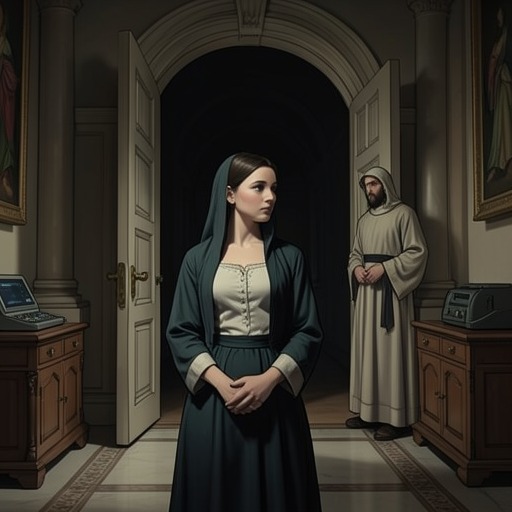
The pregnancy emerges from a society in which Cheryl’s future has been organized around reproductive duty. After Priest Quincy leads her from the temple to the palace, she is carried above the chanting crowd on a hovering stone platform and delivered toward the royal household. The public ceremony presents her as a queen whose expected role is to provide her king with children, specifically the “beautiful, dark blue babies” associated with her position. Her personal future is therefore treated as a dynastic resource rather than an open choice.
That expectation becomes unstable when Cheryl reaches the palace and discovers two men waiting below instead of one. Bjorn and Maskin are not merely rival claimants for her affection; their competing claims expose the limits of the one-king model. Cheryl eventually establishes her own condition for remaining with them: if one man has her, the other must have her as well, and they must always be together. She also makes their continued relationship conditional on their refusal to fight. Her decision creates the relational structure that later makes a three-parent child imaginable, because parenthood follows a bond she has defined rather than a role imposed by the temple.
From Sterility to Possibility
The decisive crisis begins when Cheryl learns that Maskin, as a warrior-slave, has been made sterile. The revelation shocks her because it links his social caste directly to the denial of family and inheritance. Bjorn explains that all warrior-slaves undergo sterilization, and he fears that Maskin will lose the will to fight because he believes he can never have children with Cheryl. Maskin’s sterility is therefore not only a medical condition; it is a mechanism of social exclusion that prevents a warrior from becoming a parent and keeps reproductive power within the established hierarchy.
Cheryl responds by recalling the fertility rites performed at the temple for same-sex couples. She knows that the priests can clone and combine DNA from two individuals, and she asks why the same process could not be extended to three. Bjorn initially does not know that such a procedure is possible. He explains that cloning was officially declared unviable centuries earlier, yet he also recognizes that the temples may have preserved or continued the practice. The conversation turns a seemingly impossible hope into a practical reproductive proposal.
The possibility immediately changes Maskin’s position. Bjorn tells him that he can have children and that the three of them can become parents, using the prospect to pull him back from surrender. Maskin remains unconscious, but his lips twitch into a smile when he hears that he may still have a future with Cheryl and Bjorn. Cheryl kisses him and urges him to fight, promising a household filled with children. The promise is emotionally urgent, but it also counters the warrior-slave institution with an alternative definition of worth: Maskin need not remain useful only as a fighter when he can also participate in family, lineage, and care.
Confirmation of the Pregnancy
The reproductive plan is confirmed when Cheryl returns from the fertility temple after undergoing a medical check. She initially distinguishes the news from the arrival of her new dresses, then reveals that she is pregnant. The DNA scans show that the cloning procedure has succeeded and that the child belongs genetically to all three of them. The pregnancy thus validates the temple knowledge that made the proposal possible and proves that the former prohibition against cloning was not the final word on reproductive possibility.
Bjorn and Maskin react with immediate alarm over Cheryl’s physical condition. Bjorn unties her and worries that the couple has been too rough with her, while Maskin carries her to bed and carefully settles her beneath the blankets. They offer water, food, and a foot rub, crowding around her with questions about what she needs. Their attention reverses the logic of the fertility system: Cheryl is no longer treated simply as the vessel through which a royal line must continue. Her wellbeing becomes the first concern, and the two men respond to the pregnancy as prospective fathers responsible for protecting the person carrying their child.
Cheryl, amused by their anxious care, concludes that the coming nine months will be a good period. The ending leaves the pregnancy in an expectant rather than completed state, but it gives the relationship a shared future that all three participants recognize. The child is not assigned to one king alone. Its origin is explicitly collective, and its anticipated family is collective as well.
Kinship, Technology, and Bodily Agency
The pregnancy belongs to a wider pattern in which the book treats biology as changeable, technologically mediated, and politically contested. Elsewhere, medical scans construct three-dimensional images of an embryo, bionic eyes can conceal stun grenades, and Stlozyn ancestry is explained through altered genes and added DNA that permit bodily transformation. Against that background, the cloned pregnancy is not presented as ordinary conception, but neither is it treated as an incomprehensible miracle. It is a technical intervention that combines genetic material across a three-person relationship and challenges official claims about what science can or cannot do.
The state also exposes a conflict between reproductive knowledge and institutional control. The temple has retained access to cloning practices that wider society considers unviable, while Priest Quincy’s authority is tied to regulating Cheryl’s body and reproductive role. Cheryl’s memory of temple fertility rites allows her to convert restricted or forgotten knowledge into a means of resistance. Her question is practical, but its consequence is structural: reproduction no longer belongs exclusively to the temple, the king, or the ruling caste. It becomes a shared project shaped by the people whose lives and bodies are directly involved.
Most importantly, Cheryl remains the agent who joins the three genetic contributions and defines the relationship in which the child will be raised. Her earlier ultimatum prevents Bjorn and Maskin from isolating one another, and her later proposal gives Maskin a route out of the future imposed on him. The pregnancy therefore does not merely add a child to an existing romance. It consolidates Cheryl’s chosen triad, transforms Maskin’s social condition, and converts a dynastic reproductive demand into a form of plural parenthood.
Narrative Significance and Ending State
Three-parent cloned pregnancy marks the culmination of Cheryl’s movement from temple-controlled queen to an active maker of family and political possibility. She is publicly transferred through a ceremonial spectacle designed to place her within royal reproductive service, yet the final pregnancy belongs to a household whose terms she sets herself. The hovering platform and chanting crowd symbolize the old order’s claim over her status; the quiet domestic scene in which both men worry over her body shows the new order taking shape through mutual responsibility.
The pregnancy also reconciles the apparent incompatibility between Bjorn and Maskin. Their rivalry had threatened to become physically destructive, and Cheryl explicitly warns that another fight will end her relationship with both men. The shared child gives their bond a material future, but the condition remains her rule that neither man possess her alone. In this sense, the pregnancy is not a reward for rivalry or a mechanism for choosing between kings. It is evidence that the rivalry has been redirected into a three-part family arrangement.
By the close of the story, the pregnancy is confirmed, the child’s three-parent genetic origin is known, and Cheryl is entering the expected nine-month term under the anxious care of both kings. No birth is shown in the available ending. What is completed is the transformation of possibility into certainty: Maskin is no longer defined by enforced sterility, Bjorn is no longer facing a solitary claim to Cheryl, and Cheryl’s body is no longer serving only a single ruler’s dynasty. The state stands as the story’s final image of a new family whose biology, authority, and future are shared.